I. Hold Still
The crown had been on for forty minutes and had found the place behind Padmé’s left ear where it meant to spend the day.
“Chin a fraction toward the window, Majesty,” said Halvo Tresk, from behind his plate. “A fraction. Thank you. That was two.”
She brought it back one. Tresk had been the Senate’s holographer under the Chancellor and had survived the change of management by being the only man on Coruscant who would tell an Emperor his chin was wrong. He was small and about sixty, and he arranged people as though they were fruit.
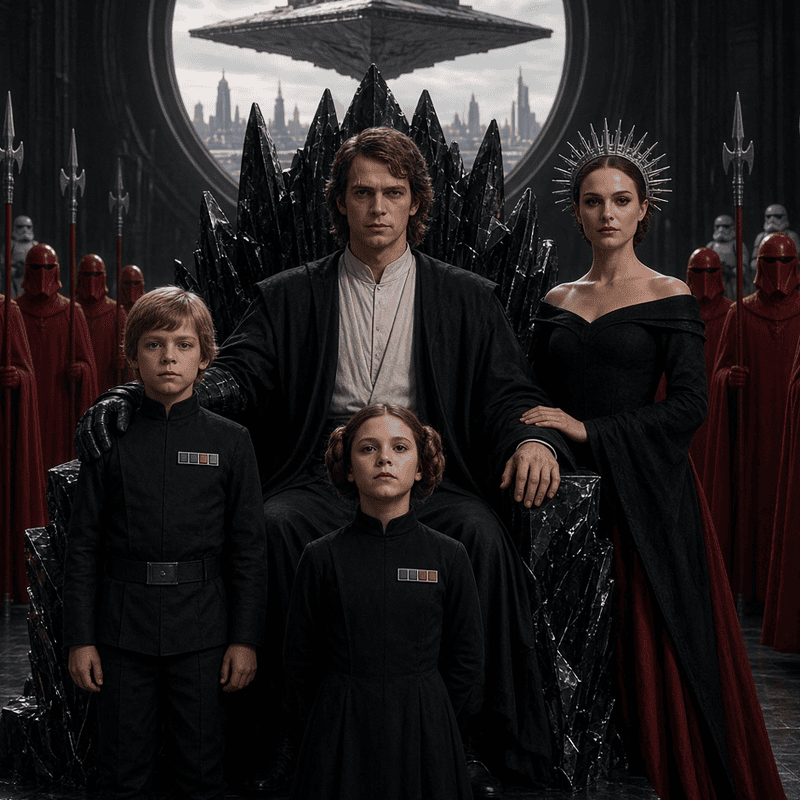
The throne room took up the whole top of the spire. Through the round window at the back of it a Star Destroyer hung over the parade route with its nose toward the palace, as it had been told to. It did not appear to be doing anything, and that was the point of it.
Anakin sat on the throne and let Tresk’s assistants move his elbows.
The throne was glass, black, grown out of a seed of Mustafar stone in a vat under the palace, and it had come up in spikes because he had wanted it to and because nobody had known how to tell it otherwise. She had said at the time that it would ruin every gown she owned. It had ruined four. He sat in it the way other men sat in a speeder they had rebuilt themselves, loose, with the black gauntlet resting open on the arm, and he had not complained in forty minutes, which for Anakin was a form of love.
“Majesty. The hand.”
Her hand went to his shoulder. Tresk had asked for it at the first sitting, when she had been too far along to stand for more than a few minutes and he had needed something to join the two halves of the picture, and she had put it there, and it had stayed. He turned his head a degree toward it now without being told. His shoulder was warm through the black.
“Prince Luke. You’re scratching.”
“I’m sorry.” Luke took his hand down from his collar and put it back where it had been. The junior officer’s tunic was new, cut like his father’s, with a rank plaque on the breast the size of a thumbnail. He stood at Anakin’s right, just forward of the arm of the throne, where the gauntlet could reach him. He was ten and blond and he stood the way his father had shown him, weight even, and every so often his eyes went to the floor between his boots and stayed there a second longer than the floor deserved.
Leia was in front, alone, because she had said at nine that she would stand in front, alone, and had been right that it made a better picture. The two buns were Sabé’s work and had taken an hour. The dress was black and plain and had its own small plaque, which she had asked for in writing. She was watching the Royal Guards.
There were twelve of them this year, in two red ranks on either side of the dais with their pikes grounded, and two files of white armor behind them along the walls to fill out the width of the window. Padmé had stopped seeing them in the second year, the way you stop seeing a wall. Leia had not stopped. Her eyes went down the left rank and up the right one, and paused, and came back to the front.
“Mother,” she said, without turning her head. “The fourth from the window, on the left. He’s new.”
“Later,” Padmé said.
“Yes, Mother.”
By the door, out of the picture, the one guard who was not in red stood with his hands behind his back and his one eye on the room. Typho had been with her since Naboo. He had never asked to be in the portrait. She had never offered.
Sabé came up the two steps of the dais with her hands already raised and settled the crown. Thin silver spikes, a hand-span high, set in a band that had been made to measurements taken when Padmé was twenty-eight. She had not been twenty-eight for some time. Sabé’s fingers found the place behind the ear and lifted a quarter of a millimeter, and the headache changed shape without getting smaller.
“Better?”
“Yes.”
It was a lie Sabé had heard before, and she went back down the steps with it.
Under the gown, under the black bodice and the boning, the japor snippet lay against Padmé’s breastbone on its cord, warm because she was. Nobody in the room knew it was there except the man under her hand, and it was the one thing she wore that Tresk had never been allowed to light.
“Hold still,” Tresk said.
The room held. Outside the window the Destroyer did not move either. The plate hummed. Padmé watched Tresk’s face past the edge of it and saw him watch the light, and saw the moment his mouth went flat.
“Someone moved.”
Nobody confessed. Tresk looked at the family the way he looked at fruit. Anakin had not moved; Anakin could sit so still that the air stopped noticing him. Leia’s chin had not shifted by a degree, and Padmé’s hand had not left the shoulder.
“I think it was me,” Luke said. “I’m sorry. I looked down.”
“Yes, Highness. At the floor. The floor will be there after.” Tresk reset something on the plate with his thumb. “Again, from the top. Majesties. Highnesses. Nobody breathe who does not have to.”
Padmé breathed, because she had to, and brought her chin a fraction toward the window, and held it there.
Portraits aside, she had held herself this still once before in her life. That time her hand had not been on him. Her back had been to him, on a landing platform, in heat that took the skin off the inside of her nose, with the two of them still inside her.
II. The Landing Platform
The skiff came down through the ash with its chrome gone the color of the river, and Anakin went out onto the platform to meet it with the council room still on his hands.
The heat here had weight. It leaned on the face. His eyes had stopped watering somewhere in the fifth hour; the Chancellor had told him that would happen, along with everything else that had happened, in the order it had happened in.
Behind him was the bunker, and in the bunker was the council, and he had done what he had come to do in less time than the Chancellor had allowed for it. Behind the bunker, behind the planet, behind last night, was the other thing, and he kept it behind him. You did not turn around on a stair and look at the step you had just left. You looked at the one in front of you, and the one in front of him was coming down a ramp with her hand on the rail.
She was near her time and she came down the ramp slowly, and the ash got into her hair at once and she let it stay. She had been crying, on the flight, and had stopped, and had done something to her face so that it would not show, and it showed. He went to her with his arms out and she let him, and he felt the baby turn against him through the two layers of her and his, and he put his face in her hair and said, “You shouldn’t have come. The air’s bad here.”
“I saw the smoke from the apartment,” she said, into his shoulder.
He left that where it was.
“It’s done,” he said. “Listen to me. The war’s over. They’re finished inside; there’s nobody left to sign anything. The Jedi tried to take the Republic, Padmé, I was in the room, and that’s finished too. He’s the only one left who can hold it and he’s old. I’m stronger than he is. I’m stronger than anyone has ever been, and I did it for you, so that the thing I saw doesn’t happen. Nothing is ever going to touch you again.” He had her by the shoulders. The next thing came out in the Chancellor’s cadence, which he noticed, and did not mind. “We can rule the galaxy together.”
She looked at his face. For a moment something in hers went a long way off, as if she had seen a thing over his shoulder, and then it came back, and she took his hands off her shoulders one at a time, the way you take down something heavy, and held them.
She did not say yes. He had been ready for yes, and he had been ready, in a part of himself he had put a wall around, for no, and that part he kept behind him with the rest.
What she said was, “Then we do it my way.”
He heard the words and found nothing in them, at first, to hold. “What?”
“You heard me. You’ve made me an offer, Anakin. I have been taking offers from men with blood on their hands since I was fourteen and I have never once taken one without terms.” It was the voice she used on the Senate floor, and he had never heard it from this close. “The Senate stays. It votes on whatever we do, and sometimes it will vote against us, and when it does, we lose. The Chancellor goes, and I do not want to know how. You never put a hand on me in anger. Either hand. The child is born on Coruscant, in daylight, with a name on a register anyone can read. And when I say stop, you stop, and you ask me why afterward.”
He had come out onto the platform with one voice in his chest, and the voice had been the Chancellor’s, and for three days it had told him what came next before he needed to ask. It stopped. He could still feel the shape of where it sat, but it stopped talking, and in the space it left he could hear her, and under her the river going by. He found he could stand in that space without falling over. He had not known, until this second, that there was anywhere to stand that was not the stair.
“Yes,” he said. “All right. Yes, my love. Your way.”
Then the air changed. A pressure came onto the back of his neck from the direction of the skiff, a draft from a door he had believed shut, and his hand came up.
Obi-Wan was on the ramp.
He had come down it quietly, and stood at the foot of it with his hands open at his sides and his face grey with ash and with something under the ash. Behind him in the hatch Threepio was saying something about the air, and nobody was listening.
Anakin’s hand was up. The right one, the one from Dooku, in its black gauntlet. The saber on his belt, the blue one he had carried since he was nineteen, hung against his hip and his hand went nowhere near it. The hand was going to be enough. He could feel the man’s throat from here the way he could feel the baby.
Padmé stepped between them.
She did it with her back to him. In thirteen years he had never seen her turn her back on a thing that could hurt her; she turned to face those; it was what she was for. She put her back to him now the way she might have turned to look out a window, her shoulders a hand’s width from his raised palm, and said to the man on the ramp, in the Senate voice, “Take the skiff. Take Threepio. Go now.”
“Padmé.” Obi-Wan did not move. He was looking past her, at Anakin, and then at the hand, and then at Anakin again. “Anakin. It isn’t finished. Whatever he told you, it isn’t finished. You can still—”
“Get on the ship,” Padmé said.
“You don’t know what he did last night.”
“I came through the Temple district to get to my own landing pad. Get on the ship.”
Anakin watched his old master do the sum. He had seen that face across a hundred briefing tables. What was on the table now was a woman near her time standing with her back to a raised hand, and the only version of the next hour in which she was alive at the end of it was the one where the skiff left without her. Obi-Wan saw that. Anakin saw him see it.
Obi-Wan looked at him one more time, and Anakin held the look and gave no answer to his own name, still hanging in the air between them, and then Obi-Wan went up the ramp. The droid went in ahead of him, still talking. The ramp closed.
The skiff lifted. The ash came off it in a sheet. It turned over the river and went up, and he followed it with the hand until it was a bright point, and then nothing, and then he brought the hand down.
He let it go. She had told him to, in that voice, with her back turned, and he had not known, until the skiff was a point of light and then less than that, how much he had wanted to be told.
She turned around then, and looked at the hand, which was at his side, and took it.
“The council’s ships are on the far pad,” he said. His voice came out ordinary. “Nobody in there is going to need them.”
“Then we’ll take one of those.”
They walked. The heat leaned on them. Coruscant was sixteen hours away at the best speed a Federation shuttle could make, and he knew what was waiting at the end of them, and he knew what was behind him, and he kept it there, and he had her arm.
III. The Restoration
The official history ran to four hundred and twelve pages and Padmé had read it twice, the second time in proof, with a stylus. It was accurate in every particular she had been able to check. It called the month after Mustafar the Restoration. On the subject of the Chancellor-Emperor it said that he had passed.
The lie had been a small one and she had broken it by being examined. On the Federation shuttle, four hours out, Anakin had told her in the dark what he had been promised: that there was a way to keep her from dying in childbirth, that the Chancellor knew it, that it was the price of the Temple and of everything since. He told it the way a man tells you the terms of a loan he has already signed. She went down to the shuttle’s medical bay and had the droid look at her, and the droid found a healthy woman of twenty-seven in the eighth month of an uncomplicated pregnancy, carrying two. It was the first anyone had told her it was two. Then she went back up and said, “I’m not dying, Anakin. There was never anything to save me from. He lied to you,” and watched him take it, and understood, watching, that the lie had been holding up the roof of the last three days and that she had just taken it out.
She did not watch the Chancellor die. She was in the corridor outside his office in the Senate building, four days after Mustafar, with Typho, because Anakin had said he would rather she were in the building and she had said she would rather not be in the room. The doors were the red ones. They stayed shut for seven minutes. There was no sound through them that she could have described afterward. Typho stood between her and the doors with his hand on his sidearm, as if there were anything a sidearm could have done about what was in that room, and she loved him for the gesture and did not say so. When the doors opened Anakin came out alone. His face was wet. He said, “He kept talking,” and she took his hand, the left one, and they went down the stairs to the chamber, and that was the paragraph the history gave to the passing of the Chancellor-Emperor, more or less, with the hand left out.
The rest of it was hers.
The Petition of Two Thousand had been written in her apartment by a handful of tired people, to say that emergency powers were a loan and the Senate wanted them back. It did not say what happened if the man holding them died. Nobody had thought he would. Read a certain way, by people who wanted badly to read it that way, it described a procedure: the powers returned to the Senate, and the Senate conferred them on whom it chose, and the Senate, that week, with the Temple still smoking at the edge of the district and the clone legions standing in the avenues waiting to be told whose they were, chose. It took one afternoon. Two thousand and some signatures became a list of people who had been, in the history’s phrase, present at the Restoration.
Bail came to see her that night.
He had been her friend for thirteen years and he did not sit down. He stood in the middle of the room with his hands behind his back and said the thing everyone in the chamber had been thinking that afternoon and nobody had said. He said, “Padmé. Now give it back.”
She had the reasons ready. She had had them ready before he came, and she laid them out in order, as she had laid out position papers at fourteen. The clone legions answered to whoever sat in the chair, and nobody alive knew how to change that. The Separatist fleets were still armed and parked, their owners dead on Mustafar, and someone would come for them by spring. The Banking Clan held paper on half the Core. A restored Republic, next month, with no army it could trust and a Senate that had just shown what it would vote for in an afternoon, would be a civil war before the year was out, and she had already lived through one of those. Every reason was true. Bail knew it; she watched him know it, one at a time.
What she had not expected was the other thing, under the reasons, which she heard while she was talking and did not stop to look at. It was pleasure. She had been good at this since she was fourteen and had never, in thirteen years, been allowed to do it without a committee, and here was a room with no committee in it, and the reasons coming out of her in order, true, and a man she loved not finding the hole in them, and she imagined that was what flying felt like to Anakin. She noticed it, and went on talking.
“You’ve told me why you can’t,” he said, when she had finished. “I asked whether you would.” She started again from the clone legions, and he let her get as far as the Banking Clan and said, “Then tell me when,” and she did not have a number for him, and he saw that too.
Bail went home to Alderaan at the end of the session. He did not come back for the next one, and in the third year his seat was filled by a man whose name she had to look up. He was well. She had people whose work it was to tell her he was well, and they told her, quarterly. Mon Mothma stayed for the vote, and was not in her office the next morning, and the office was reassigned by the end of the week. Padmé did not ask. She had an idea of the two or three possible answers, and the question went into the category of things that were not done, and had stayed there.
The twins were born six weeks after the vote, on Coruscant, in daylight, with their names on a register. Leia first, which Leia had never let anyone forget. Luke eleven minutes after, as though he had been asked and had thought about it. Anakin was in the room. The droids had said he could not be, and he had stood against the wall with his back flat to it and not left, and the droids had stopped mentioning it. When they put Leia in his arms, the left one, the one that could feel her, he held her the way a man holds something he has been told is live, and then he did not want to give her back. Padmé watched him from the bed and thought: this. She was careful, even then, with the room still full of the smell of it, not to finish the sentence.
The Temple had been standing empty since the night before Mustafar, and the engineers said the central spire was sound. She asked Anakin, in the first year, whether he could live in it. “It’s already there,” he said, “and the bones are good,” and he said it the way he said everything, as a measurement, and she waited for the rest of the sentence and there was no rest. They built up. The spire went another two hundred meters and the window went in at the top, facing the parade route, because Tresk had said a picture needed somewhere for the eye to go. The lower levels kept their floor plan, because nobody had wanted to be the one to draw a new one. One work order came up from those levels in the first year, for masons, to close a row of doors along one corridor, and it crossed her desk with the rest. She read everything with a stylus, to the end. She initialed that one at the top. The children learned to walk on stone that had been laid before the Republic was old.
They grew in jumps. Leia talked first and had not stopped. Luke walked first and then went back to crawling for a week because he had thought of something. Leia declined the training at eight, in writing, and Anakin read the note twice and folded it and said, “All right,” and Padmé watched him not ask again for two years. Luke went down to the training floor with him every morning and came back quiet. She did not ask about that either. There was a limit to the number of things one woman could listen for, and she had found hers somewhere in the fourth year, and had drawn a line there.
She had said stop to him four times in ten years. He had stopped each time, the whole of him, at once, and then had taken two or three days to come back to himself, and the children had noticed the days. The last time had been in the sixth year. The Senate had voted against them twice in ten years, and she had chosen both occasions.
Out past the window the galaxy was quiet. Ten years of it. It was quiet the way a held breath is quiet, if you listened for the kind of quiet it was, or read the morning dispatches past the column headed Pacification, and both of those were on the far side of the line.
“Majesty,” said Tresk. “One more, if you would. The hand.”
She looked down. It had not moved.
IV. The Children
Tresk called the rest at the second hour and Luke was out of the throne room before the first guard had shifted his weight.
Artoo was in the anteroom, where Artoo always was, and fell in at Luke’s knee without being asked. The droid had been his father’s, in the war; nobody had ever said anything about that, and at some point the household had begun writing him down on the duty lists as the prince’s astromech, and his father had seen the list and said nothing.
The lift went down a long way. He counted eighty-one floors, and then the floor numbers stopped being numbers and became letters. That was the old part.
The corridor he liked was on the lowest lettered level. Nobody had changed the stone down here, except along the one wall, and that had been done early. The stone was pale, and worn into a shallow place in the middle of each flagstone. The air was cool in a way the air upstairs was not, and it smelled of nothing at all.
He scratched, now that nobody was there to see, and it did not help much.
There were places in the palace where the floor was colder than the floor around it.
The hand could not find them. He had tried with the hand, at seven, and the stone had been the same temperature as any stone. The cold was in the other thing, the part of him his father had been teaching him to use since he was six, the part that knew where Leia was in a building without looking and could feel the Destroyer in the window as a kind of weight.
He had learned not to mention them. His mother could not feel them; he had tried to explain once, at eight, and she had listened with her whole face, and then had the medical droid look at him for two days. His father could feel them. He was nearly sure. He had said once on the training floor, “There’s a cold place by the east stair,” and his father had gone quiet, a kind of quiet Luke had never heard him use on anybody else, and after a while had said, “Yes,” and then, “Lift the block again.” Luke thought his father knew exactly where the cold places were. He thought his father walked around them.
He was good at the lifting. He could take a training block the size of Artoo off the floor and hold it at head height for a count of two hundred without the shake coming into his arm, and his father had said so in front of the guards, so Luke knew it was true. He was bad at the other part. His father had tried, once, to show him how you took the thing in your chest when somebody had hurt you and put it into your hand, and Luke had looked for the thing in his chest and found there was not very much of it there, and what there was he had not wanted to pick up. His father had watched him try for a long minute. Then he had said, “All right,” and put the block back. He had not tried to show him again. Luke noticed that most mornings, and carried the noticing around with him, like the plaque.
Upstairs, in the halls his father walked to get anywhere, the cold places were the size of grown people, or bigger, and far apart, one here and another at the far end of a gallery, as though whoever had left them had been moving fast. Down here they were small. There were a great many of them, close, all along the left-hand wall at regular intervals, where you could see in the stone that there had been doors once, a row of pale rectangles each a little wider than his arms could reach, made good with newer stone that had never quite matched. One cold place to a rectangle. Some of the rectangles had two.
He had never told anybody what he did about them, because it did not sound like anything. He stood in them. He had decided that a cold place was a place something had been left in, the way you leave a glove on a bench, and that there was nothing he could do about that except be there. The fourth rectangle on the left was coldest. He went to it and stood in it with his boots side by side and his hands at his sides, and the collar itched, and he did not scratch.
Artoo settled onto his third leg a little way up the corridor and dimmed his dome. That was what Artoo did instead of talking.
The cold came up through the soles of his boots. He let it. It was the cold of a room that has been shut a long time, and for as long as he stood in it, as far as he could tell, the room was not shut. He did not know whether that was true. He stood there anyway, with the plaque pulling at the cloth over his heart, and counted, because counting was how you held a block up and he supposed it was how you held anything up, and he had got to three hundred and forty when Artoo’s dome came back on and the droid made the low sound that meant the lift.
He stepped out of the cold place carefully, the way you step off a sleeping animal.
When the guard came around the corner Luke said he had been looking at the floor, which was true and did not sound it. The guard gave him the look grown people gave him when they had children of their own at home, and said, “Yes, Highness,” and walked him to the lift.
Leia went up.
Her mother’s Senate office had come to the palace in the second year, in crates, and everyone still called it the Senate office, including the duty roster. It was a records room now. The speeches were in it. She had been reading them in order for a year and a half, an hour at a time, and had got as far as the end of the war.
Sabé was there, because Sabé was usually there when Leia was, by a coincidence Leia had stopped believing in. She was sorting flimsi at the far table with her back half turned, which was how Sabé kept an eye on people.
The Petition of Two Thousand was in a flat case under glass, on the wall where the window had been in the old office, and it was shorter than Leia had expected. Most important things were, in her experience, which was ten years long and had been paying attention for about six of them. It used the word “return” four times in two pages. She read it twice, with her hands behind her back like a guard, and then the signatures.
The first one had been inked out. Somebody with a steady hand and good black ink had drawn a bar through it, long enough ago that the bar had gone brown at the edges. Leia noted it and did not ask about it. She had learned early to spend questions the way her mother spent money, one at a time, on the thing she could get. The second signature was Amidala, which was the name her mother put on anything meant to outlive her. The third was Organa.
Every Life Day a plain crate came with Alderaan customs seals on it and no card, one thing in it for her and one for Luke, and it had never been the wrong thing. Last year, for Luke, it had been a knife with a wooden handle, which Mother had looked at for a long moment and then let him keep. Nobody signed it. She had worked out who sent it at seven, from the seals and from how Mother’s face did nothing when the crate came in, and she had been keeping the name since then the way you keep a key to a door you have not found yet.
“Sabé,” she said. “Why doesn’t Senator Organa come to Coruscant?”
Sabé’s hands stopped for the length of one breath, which in Sabé was an event, and then went on. “Viceroy Organa retired from the Senate some years ago, Highness. For his health. He lives on Alderaan. He’s well.”
“Is he allowed to come?”
“He is welcome on Coruscant whenever he chooses to travel.”
Leia took that apart where she stood. Welcome. Chooses. Two words with a job each, and a space between them a person could live in for ten years. “Does he choose to?”
“He has not so far.”
“Thank you.” She looked at the signature a moment longer. “Has anybody asked you that before?”
“Not in nine years, Highness,” Sabé said, and that was more than the court’s answer, and they both heard it, and Sabé went back to the flimsi and Leia let her.
She filed it. She had a place for things like that, and she did not yet know what it was for. She would find out.
Then she went back to the other thing. The guard. Fourth from the window, left rank. The others stood with their weight back in their heels, the way men stand who have stood for a living and have learned where the ache goes. He stood with his weight forward, like somebody who expected to have to move. Either he was new or he was something else, and that was the kind of question you took to Dad. She would tell him when the sitting was done, and he would not laugh. He had never laughed at anything she counted. He would go and stand in front of the man for a while, saying nothing, and afterward he would come and find her and tell her which. Mother would have said “Later.”
V. The Exposure
They came back into the room in the order they always came back into rooms. Leia first. Then Luke, with the droid, who was sent to wait in the anteroom. Then Padmé, with Sabé at her elbow doing something to the back of the crown that made Padmé’s eyes close for a second and open.
Tresk wanted the hand on the boy. He put it there.
The gauntlet was heavy. Luke’s shoulder took it as it had last year and the year before, with a half second of settling and then nothing, the boy standing up under it as though it were his own weight and somebody had just handed it back. He had grown since the last portrait; the arm had to come up further to reach him. From the chair Anakin could feel the collar on the boy, the itch of it under the cloth, the same as he could feel the boy’s pulse. The boy was not scratching. Anakin left him to it, because he was managing.
Padmé’s hand came onto his left shoulder and he turned his head a degree toward it. Nobody had ever needed to tell him to do that.
Leia stood in front, out of reach, where she had put herself at nine and where, he thought, she would stand for the rest of his life. Chin up. Looking at Tresk’s plate as if it had been asked a question. She looked at everything that way.
“Hold still,” Tresk said.
He held still. It was the easiest thing anybody ever asked him to do.
He could feel the room. All of it. The guards in red and the two files in white behind them, each one a small steady warmth with a pulse in it, bored, with the third-hour ache in their knees, the fourth on the left no different from the rest. Tresk and his two. Typho by the door with his one eye, who did not like him and had never pretended to. Sabé. His wife, whose headache he could feel from here as a pressure just behind his own left ear. His son under his hand. His daughter, in front, who would not be touched, and who he could have found blindfolded on a planet.
And the others. Far down, in the old part, where the floor remembered. He did not go down to them. He had got good at walking a hallway with them in it without turning his head. The boy went down to them. He knew that. He had felt the boy an hour ago standing in one, standing in it like a lamp somebody had left on in an empty house, and he had said nothing and would say nothing, because he had not taught him that, and he was afraid that if he asked, the boy would stop.
He had everything. He made the list some nights, when the children were asleep or pretending and Padmé was reading with the crown off and the mark of it still behind her ear. It was a short list and all of it was in this room and nothing on it was going to die. He had been promised that once by a man who was lying, and then it had turned out to be true anyway, and he had never worked out what to do with that.
In the stillness he did what he did when he thought nobody could tell. He reached.
Back through the window behind him, past the Destroyer in it, along a direction he had never been able to name. Obi-Wan. He found what he always found: a pressure, a long way off, like weather over a sea he was not on, and under the pressure, every time, for ten years, the sense of being looked at back.
He did not mind it. He had thought about why he did not mind it and had decided it was because it meant two things, that the man was alive and that the man was not coming, and either one alone would have been hard, and both of them at once was a thing he found he could sit in a chair with.
The plate hummed. The room came up around him, warm: her hand on his shoulder, and his son’s shoulder under his hand, and in front of all of it his daughter’s straight back, nobody’s to touch. And out of it, from no direction he could point to, the room gave him back a word. The one he had said on the platform with the river behind him and had not said since, because nothing since had needed it. Together. He did not say it now either. He held it the way he held the boy.
The flash went.
Tresk looked at his plate and was silent for a moment, and from Tresk that meant it was good. From the throne Anakin could see the image on it, small and sharp: the window with the Destroyer in it, the two red ranks cut off at the edges where the frame stopped, and in the middle the four of them at the one angle from which all four were in the picture at once, and past the edge of the plate, nothing.
“Thank you, Majesties,” Tresk said. “Highnesses. One more, for safety. Hold still.”
Nobody moved. Under his hand the boy’s shoulder stayed where it was. On his own shoulder her hand stayed where it was. Under the black of her gown, against her breastbone, where he knew it was without looking, the japor snippet moved a little with her breathing.